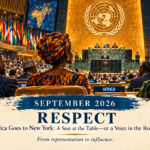
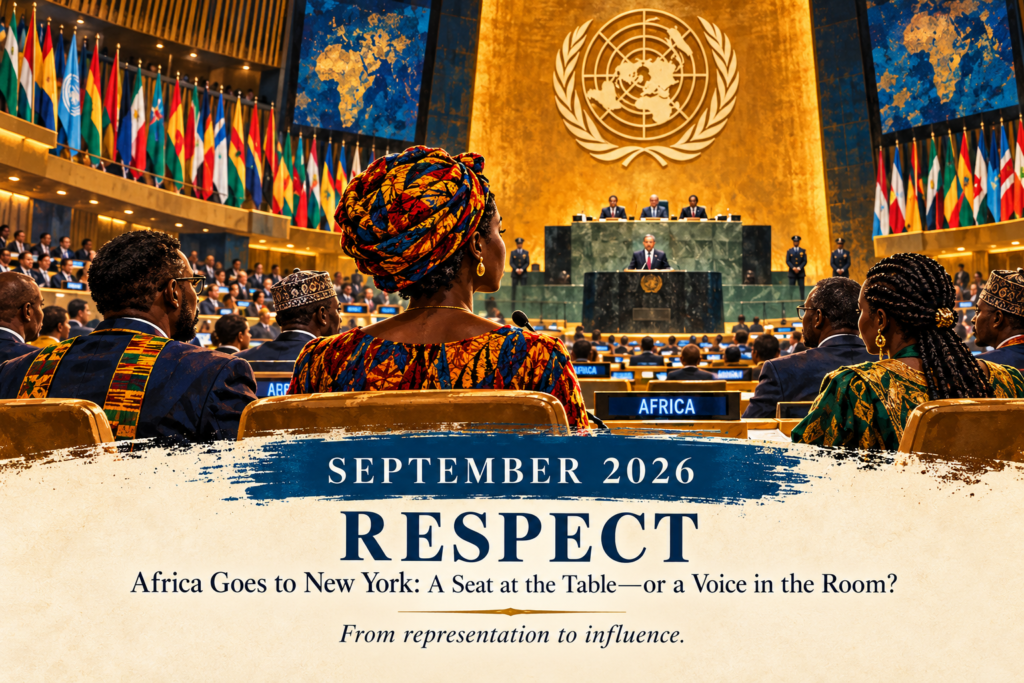
In September, world leaders gathered in New York for the 81st United Nations General Assembly under a striking theme:
Restoring Trust, Managing Transformation: A United Nations That Delivers for All.
The African Union arrived with a clear message: Africa needs a stronger voice in shaping global decisions, including more meaningful representation within the United Nations Security Council and international financial institutions.
This is fundamentally a conversation about respect.
There is an important difference between being invited into a room and influencing what happens inside it.
Africa participates in the world’s institutions. Yet on issues ranging from climate finance and debt to peace, technology and global governance, the deeper question remains:
Is Africa represented—or genuinely heard?
Respect between nations is remarkably similar to respect between individuals.
It means listening without condescension.
Recognising another’s experience.
Sharing decision-making power.
And accepting that partnership is different from patronage.
Africa should not approach the world claiming that it possesses every answer. We have difficult work of our own to do—on governance, corruption, conflict, inequality and opportunity.
But neither should Africa enter global conversations as a perpetual supplicant.
Our continent possesses extraordinary human capital, natural resources, cultural intelligence, entrepreneurial energy and one of the world’s youngest populations.
And those young Africans will inherit decisions being negotiated today—from AI governance to climate policy and the architecture of international finance.
Their voices belong in those conversations too.
Our journey this year began with From “Me” to “We.”
Perhaps UNGA offers us an opportunity to take that idea beyond ourselves.
There cannot be a credible global “We” if some voices matter more than others.
Ubuntu teaches us:
I am because we are.
Perhaps Africa’s message from New York should therefore be equally simple:
Respect is not merely giving Africa a seat at the table.
Respect is recognising its right to help shape the table itself.