
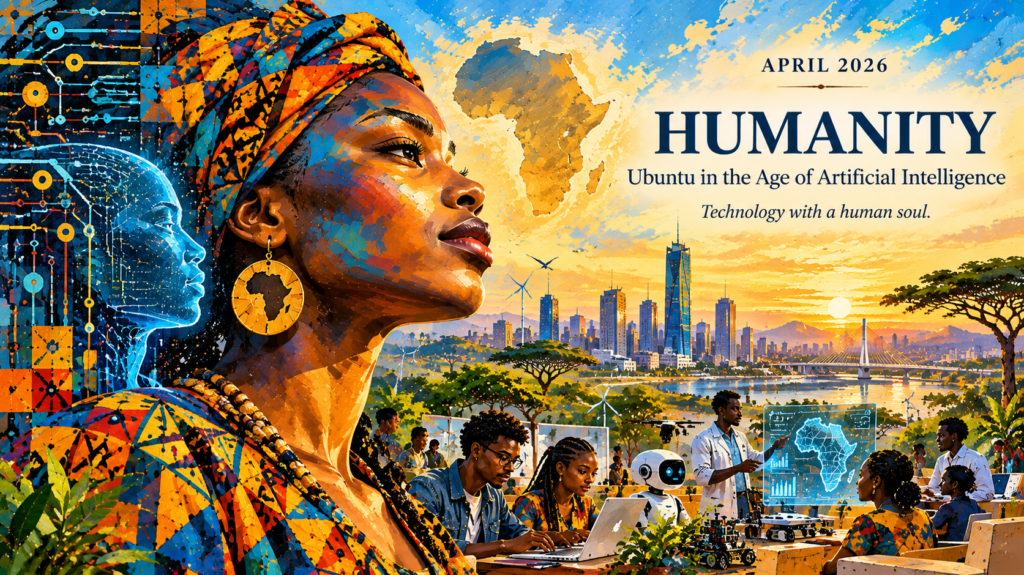
Artificial intelligence may become one of the defining technologies of our generation.
Across Africa, the conversation has moved quickly from curiosity to application. At the African Science, Technology and Innovation Forum in Addis Ababa, governments, academia, business and civil society examined how science and digital innovation can accelerate African development. A parallel dialogue specifically addressed inclusive and responsible AI governance and Africa’s collective voice in shaping the rules surrounding this technology.
This presents Africa with an extraordinary opportunity.
But also an important question.
What happens to humanity when technology becomes increasingly powerful?
Ubuntu offers an intriguing compass: I am because we are.
Technology can calculate faster than us. AI can analyse enormous quantities of information, automate tasks and increasingly imitate capabilities once considered uniquely human.
But efficiency is not empathy.
Data is not wisdom.
Intelligence is not necessarily humanity.
Africa should absolutely participate in the AI revolution—not merely as a consumer of technologies designed elsewhere, but as a creator, investor and rule-maker.
Yet perhaps our greatest contribution could be insisting that technological advancement remains connected to human advancement.
Does AI improve the farmer’s productivity?
Does it make healthcare more accessible?
Can it help a teacher reach more children?
Does it create opportunity rather than deepen exclusion?
The most sophisticated society is not necessarily the one possessing the most sophisticated technology.
It may be the society wise enough to know what technology should never replace.
Compassion. Community. Judgement. Human connection.
Our challenge is therefore not simply to build an African AI future.
It is to ensure that future remains profoundly human.